

- Boris Johnson news — live: Geidt resignation letter says PM put him in ‘odious position’ The Independent
- Lord Geidt quits as Boris Johnson's ethics adviser BBC
- Lord Geidt quit after being asked to approve 'deliberate' breach of ministerial code, resignation letter shows – UK politics live The Guardian
- Johnson’s allies will quietly rubbish Geidt as a fuddy-duddy courtier – but the damage to the PM is done The Independent
- Keir Starmer's biggest problem is not being 'boring' — it is his lack of vision Financial Times

Prime minister Boris Johnson's plan to abolish the post of Downing Street ethics adviser following the abrupt resignation of Christopher Geidt has triggered outrage in Westminster.
Lord Geidt – the second adviser to resign in less than two years during Mr Johnson’s premiership – said he was put in an “impossible and odious” position when asked to advise on a plan to maintain tariffs on Chinese steel in a way which would breach UK obligations under the World Trade Organisation (WTO).
In a resignation letter - published in full on Thursday morning after No 10 came under pressure when it initially released only a short statement - the former adviser also said he had only opted to stay in his role “by a very small margin” over the Partygate scandal.
The Committee on Standards in Public Life (CSPL) has issued a stern warning to the PM not to go ahead with plans to replace the high-profile adviser with an anonymous committee of officials to oversee the ministerial code of conduct.
Scrapping the adviser’s post would be “a backwards step” which would “risk further damage to public perceptions of standards”, said CSPL chair Lord Evans.
PM risked deliberate breach of ministerial code, says Lord Geidt
Lord Geidt in his resignation letter to the prime minister Boris Johnson said that he had been only credibly clinging onto the role of ministerial interests adviser “by a very small margin” over partygate.
He added he was forced to quit when he was tasked with offering a view on the Government’s “intention to consider measures which risk a deliberate and purposeful breach of the ministerial code”.
In the letter published on Thursday, Lord Geidt wrote: “This request has placed me in an impossible and odious position.”
Outrage over PM’s plan to abolish Downing Street ethics monitor
Boris Johnson has triggered outrage in Westminster with plans to abolish the post of Downing Street ethics adviser, after Christopher Geidt quit in protest at being asked to endorse deliberate rule-breaking by the prime minister.
Lord Geidt – the second adviser to resign in less than two years during Mr Johnson’s premiership – said he was put in an “impossible and odious” position when asked to advise on a plan to maintain tariffs on Chinese steel in a way which would breach UK obligations under the World Trade Organisation (WTO).
The PM’s official spokesperson confirmed that Mr Johnson plans to “take time” to consider whether to appoint a replacement for the former private secretary to the Queen, or to find a different way of fulfilling the function of scrutinising ministerial behaviour.
The Committee on Standards in Public Life (CSPL) issued a stern warning to the PM not to go ahead with plans to replace the high-profile adviser with an anonymous committee of officials to oversee the ministerial code of conduct.
Scrapping the adviser’s post would be “a backwards step” which would “risk further damage to public perceptions of standards”, said CSPL chair Lord Evans.
Tory MP Richard Graham – who is not usually among Mr Johnson’s public critics – said that any notion of axing the adviser’s post should be “dropped fairly fast”. Labour deputy leader Angela Rayner said Mr Johnson had “debased standards and rigged the rules for far too long”.

The PM's ethics adviser has quit a day after saying there was a "legitimate question" about whether Boris Johnson broke ministerial rules over Partygate.
Lord Geidt did not give a reason for leaving the role he took in 2021, but said it was the "right thing" to do.
His predecessor, Sir Alex Allan, quit in 2020 after Mr Johnson overruled him over a report into alleged bullying by Home Secretary Priti Patel.
The government said it was "surprised" by Lord Geidt's decision.
"Whilst we are disappointed, we thank Lord Geidt for his public service," a spokesperson added.
The spokesperson gave no reason for the resignation but said Lord Geidt had been asked this week "to provide advice on a commercially sensitive matter in the national interest, which has previously had cross-party support. No decision had been taken pending that advice".
No 10 did not make it clear what these comments referred to.
Justice Secretary Dominic Raab said there were "questions around the detail of the resignation" and said No 10 would provide an update later on Thursday.
He added that Lord Geidt had had a "pretty rough grilling by MPs this week" and that media an politicians "maybe underestimate how civil servants feel with that kind of scrutiny".
Explain why Partygate did not breach code, PM told
PM's Partygate fine may have broken code, MPs told
Boris Johnson appoints new ministerial standards adviser
A Downing Street source told the BBC that Lord Geidt's resignation had been a "total surprise and a mystery" to the prime minister, adding: "Only on Monday Lord Geidt asked if he could stay on for six months."
Labour's Chris Bryant, chairman of the Commons' Committee on Standards and Privileges, told Radio 4's Today that Lord Geidt's resignation letter should be published, adding: "I hope the Cabinet Office will publish that letter today,"
Sir Philip Mawer, a former parliamentary commissioner for standards, echoed these calls and said: "If the letter and the prime minister's reply are not published then I think people will draw their own conclusion and it will not be favourable."
He said he had been "disappointed but not surprised" at Lord Geidt's resignation, adding there had been a "succession of failures" on the part of the prime minister and "it's not just Partygate".
Labour deputy leader Angela Rayner said: "The prime minister has now driven both of his own handpicked ethics advisers to resign in despair.
"If even they can't defend his conduct in office, how can anyone believe he is fit to govern?"
Liberal Democrat chief whip Wendy Chamberlain said: "When both of Boris Johnson's own ethics advisers have quit, it is obvious that he is the one who needs to go."

Who is Lord Geidt?
Born in 1961, Christopher Geidt is a former army intelligence officer who later worked as a diplomat in Sarajevo, Brussels and Geneva
In 2002, he began working for the Royal Household and served as the Queen's private secretary for 10 years from 2007
He stepped down after a "power struggle" between Buckingham Palace and the Prince of Wales, the Times reported in 2017
Lord Geidt is chairman of King's College London and also chairs a board of the investment firm Schroders
He lives on the Isle of Lewis in the Outer Hebrides, where he grew up and where he now has a sheep farm. He is married with two daughters
Former cabinet secretary Lord Turnbull said of Mr Johnson: "The pattern of behaviour is that anyone who has the power to criticise, obstruct or force him to change, he will try to reduce their power, suborn them or in the last resort wave them aside."
But he told BBC Newsnight that "the charge sheet of Boris Johnson's conduct is now so long that one accusation isn't going to make any difference", adding the prime minister would only leave office if he was removed as Tory leader by MPs.
It was reported that Lord Geidt had threatened to quit last month after the publication of the Sue Gray report into lockdown breaches in Downing Street unless Mr Johnson issued a public explanation for his conduct.
Appearing before a committee of MPs on Tuesday, Lord Geidt said: "Resignation is one of the rather blunt but few tools available to the adviser. I am glad that my frustrations were addressed in the way that they were."
But, in a brief written statement on Wednesday, he said: "With regret, I feel that it is right that I am resigning from my post as independent adviser on ministers' interests."
Geidt's discomfort in the job was evident

On Wednesday evening, Lord Geidt phoned the prime minister's principal private secretary to tell him he was resigning. Mr Johnson was informed of the decision at about 18:30 BST, shortly after finishing a phone call with Ukraine's President Volodymyr Zelensky.
But while the particular timing has surprised some in Downing Street, Lord Geidt's discomfort in the job has been evident for a while.
Just last month he had said in a report that it was a legitimate question to ask if Boris Johnson had breached the ministerial code by breaking Covid laws.
Lord Geidt also spelled out in the report that he didn't like the terms of his job - "the prevailing arrangements still remained insufficiently independent to be able to command the confidence of the public" as he put it.
But the truth is we don't yet know definitively why Lord Geidt resigned, as his resignation letter has not been published - which itself is unconventional.
The prime minister is expected to write back to Lord Geidt on Thursday morning, and that reply may well be made public.
Read Chris's full analysis
Mr Johnson was fined in April over a surprise birthday party in his honour that he attended in Downing Street in June 2020.
Writing to Lord Geidt afterwards, he said there had been "no intent" to break Covid regulations", and that he had been "fully accountable to Parliament and the British people".
The ministerial code, which outlines the rules government ministers must follow, says there is an "overarching duty" on them to comply with the law.
If the code is broken, the convention in Westminster is for a minister to resign.
In his annual report on ministers' interests, published on 1 June, Lord Geidt said questions around Mr Johnson's behaviour had led to an "impression... the prime minister may be unwilling to have his own conduct judged against" the ministerial code.
He said that, when it came to the Partygate fine, "a legitimate question has arisen as to whether those facts alone might have constituted a breach of the overarching duty within the ministerial code of complying with the law".
Following Lord Geidt's resignation, Tory MP William Wragg, whose Public Administration and Constitutional Affairs Committee questioned the adviser on Tuesday, described him as "a person of great integrity, motivated by the highest ideals of public service".
Mr Wragg, a critic of Mr Johnson, added: "For the PM to lose one adviser on ministers' interests may be regarded as a misfortune. To lose two looks like carelessness."
But, in a brief written statement on Wednesday, he said: "With regret, I feel that it is right that I am resigning from my post as independent adviser on ministers' interests."
Geidt's discomfort in the job was evident
On Wednesday evening, Lord Geidt phoned the prime minister's principal private secretary to tell him he was resigning. Mr Johnson was informed of the decision at about 18:30 BST, shortly after finishing a phone call with Ukraine's President Volodymyr Zelensky.
But while the particular timing has surprised some in Downing Street, Lord Geidt's discomfort in the job has been evident for a while.
Just last month he had said in a report that it was a legitimate question to ask if Boris Johnson had breached the ministerial code by breaking Covid laws.
Lord Geidt also spelled out in the report that he didn't like the terms of his job - "the prevailing arrangements still remained insufficiently independent to be able to command the confidence of the public" as he put it.
But the truth is we don't yet know definitively why Lord Geidt resigned, as his resignation letter has not been published - which itself is unconventional.
The prime minister is expected to write back to Lord Geidt on Thursday morning, and that reply may well be made public.
Read Chris's full analysis
Mr Johnson was fined in April over a surprise birthday party in his honour that he attended in Downing Street in June 2020.
Writing to Lord Geidt afterwards, he said there had been "no intent" to break Covid regulations", and that he had been "fully accountable to Parliament and the British people".
The ministerial code, which outlines the rules government ministers must follow, says there is an "overarching duty" on them to comply with the law.
If the code is broken, the convention in Westminster is for a minister to resign.
In his annual report on ministers' interests, published on 1 June, Lord Geidt said questions around Mr Johnson's behaviour had led to an "impression... the prime minister may be unwilling to have his own conduct judged against" the ministerial code.
He said that, when it came to the Partygate fine, "a legitimate question has arisen as to whether those facts alone might have constituted a breach of the overarching duty within the ministerial code of complying with the law".
Following Lord Geidt's resignation, Tory MP William Wragg, whose Public Administration and Constitutional Affairs Committee questioned the adviser on Tuesday, described him as "a person of great integrity, motivated by the highest ideals of public service".
Mr Wragg, a critic of Mr Johnson, added: "For the PM to lose one adviser on ministers' interests may be regarded as a misfortune. To lose two looks like carelessness."

A summary of today's developments
The prime minister’s spokeperson refused to confirm that Lord Geidt will definitely be replaced as the PM’s ethics adviser. The spokeperson said that having a process for ensuring standards are maintained by ministers was “vitally important”. Geidt said in his resignation letter that the final straw was a request to consider a proposal that he said would be a “deliberate and purposeful” breach of the ministerial code. He implies that Boris Johnson asked him to approve of this breach.Jacob Rees-Mogg, the Brexit opportunities minister, told Newsnight’s Nicholas Watt that the Geidt resignation saga is really a story about Boris Johnson “protecting the British steel industry”. (See 1.45pm.) At the Downing Street lobby briefing, the prime minister’s spokesperson said ministers would not be getting directly involved in talks to stop the rail strikes next week. The Foreign Office has announced a fresh wave of sanctions against Vladimir Putin’s allies, including on officials involved with the “barbaric treatment of children in Ukraine”.Nicola Sturgeon has claimed the Conservatives are “terrified” of another vote on Scottish independence after the party’s leader in Scotland challenged her priorities. Witnesses should not be able to avoid giving evidence at inquiries after “an increasing number of rich and powerful” people have done so in recent years, MPs have said. As PA Media reported, the Commons committee of privileges has published a report recommending the introduction of legislation that would ensure parliament can compel witnesses to turn up to the House of Commons when summoned.
13h ago 17.32
Hundreds of Ukrainians welcomed to England since Russia’s invasion have been left homeless or are threatened with homelessness, new figures show.
Families allowed to come to the country either to join relatives or as part of the Homes for Ukraine sponsorship scheme have instead found accommodation unavailable or had arrangements to house them break down.
A total of 660 Ukrainian households were owed a statutory homelessness duty by local authorities in England in the period up to 3 June, according to the Department for Levelling Up, Housing and Communities.
A government spokesperson said: “More than 77,200 Ukrainians have arrived in the UK since Putin’s invasion and all arrivals have access to benefits and public services, as well as the right to work or study, from the day they arrive.
“The overwhelming majority of people are settling in well but in the minority of cases where family or sponsor relationships break down, councils have a duty to ensure families are not left without a roof over their head.
“Councils also have access to a rematching service to find a new sponsor in cases under the Homes for Ukraine scheme.”
Hundreds of Ukrainian refugees left homeless in England, data shows
The Guardian’s editorial independence has never been more important. No one sets our agenda, or edits our editor, so we can deliver high-impact, trustworthy journalism each and every day. Free from commercial or political influence, we can report fearlessly on world events and challenge those in power.
And because we believe in information equality, we keep Guardian journalism open for everyone to read, regardless of their ability to pay for it. No matter how unpredictable the future feels, we will continue to provide quality reporting so we can all make decisions about our lives, health and security – based on fact, not fiction.
Support the Guardian from as little as $1 – it only takes a minute. Thank you.
Plans for a new inland border facility (IBF) in Dover will no longer go ahead, HM Revenue & Customs (HMRC) has announced.
It was hoped a new facility, located at a business park off the A2 in Kent, would see millions of pounds of investment in the area and create 400 jobs.
However, HMRC has announced it will no longer go ahead with opening the site.
13h ago17.02
The FDA, the union that represents senior civil servants, has expressed concern about No 10 saying it might not replace Lord Geidt as independent adviser on ministerial standards. Dave Penman, its general secretary, said:
The ministerial code is the only mechanism a civil servant can use to raise a complaint of misconduct, bullying or sexual harassment against a minister.
Confidence in that process has already been severely damaged by the prime minister’s refusal to accept that the home secretary had breached the code, despite being found to have bullied staff.
If the prime minister does not intend to replace Lord Geidt, then he must immediately put in place measures that ensure a civil servant can, with confidence, raise a complaint about ministerial misconduct.
That’s all from me for today. My colleague Nadeem Badshah is now taking over.
13h ago16.49
In a blog on the Geidt resignation, the legal commentator David Allen Green points out that Brexiters such as Jacob Rees-Mogg used to be rather keen on the idea of trading on WTO terms - terms which, in one case at least, the government now seems willing to ignore. Here’s an extract.
You may recall government-supporters during Brexit clamouring for the United Kingdom to trade on ‘WTO terms’.
It often seemed they did not know what that actually meant, and it was said because it sounded good.
Well.
It seems that the government of the United Kingdom is as contemptuous of this type of international law as it is of others.
This is from Adam Bienkov at Byline Times.
13h ago16.41
In the House of Lords there was a repeat of the urgent question on Lord Geidt’s resignation this afternoon. Natalie Bennett, the former Green party leader, asked why “Geidt, an ethics adviser, was asked to give advice on compliance with international law over steel tariffs but Sir James Eadie, first Treasury counsel, was not asked about the legality of plans for the Northern Ireland protocol”. Lord True, the Cabinet Office minister who was responding for the government, said he would not discuss speculative comments on a commercially confidential matter.
 Natalie Bennett Photograph: House of Lords
Ministers have faced questions about why plans to reform the private rented sector did not do more to address rising rents amid the cost of living crisis.
As PA Media reports, the government published a white paper today setting out its plans to make the rented sector fairer. Under the plans, section 21 “no-fault” evictions will be banned, the decent homes standard will be extended to this sector, arbitrary rent review clauses will be disallowed and renters will get extended rights.
The white paper proposes that it also be made illegal for landlords or agents to place blanket bans on renting to families with children or those in receipt of benefits.
The plans in the white paper will form the basis of a renters’ reform bill that the government has promised in this session of parliament.
In the Commons, Matthew Pennycook, the shadow minister for housing and planning, said the plans did not go far enough to protect tenants from steep rent rises. He told MPs:
In none of the coverage this morning or in the white paper itself is there any sign of meaningful proposals to address the problem of unreasonable rent rises.
A one-year rent increase limit, the removal of rent review clauses, and vague assurances about giving tenants the confidence to challenge unjustified increases at tribunal is simply not good enough.
Updated at 16.54 BST
14h ago16.11
Geidt resigned as a result of Johnson 'protecting the British steel industry', says Rees-Mogg
Jacob Rees-Mogg, the Brexit opportunities minister, has told Newsnight’s Nicholas Watt that the Geidt resignation saga is really a story about Boris Johnson “protecting the British steel industry”. (See 1.45pm.)
John Pullinger, chair of the Electoral Commission, has said that the Elections Act that became law earlier this year is a threat to the independence of his organisation. The new legislation allows ministers to issue a strategy and policy statement giving directions to the commission and, in an interview with Prospect, Pullinger said this was incomptible with his organisation being independent.
Although he stressed he would continue to do his job independently and impartially, he said:
Most people would think that the government of the day has only one strategy and policy priority for the next election, and that’s to win it for themselves. Powers on the face of a bill like that are inconsistent with the Electoral Commission acting as an independent regulator.
The commission is in charge of ensuring that elections are carried out fairly, and that election spending rules are enforced.
Scottish Tory leader Douglas Ross accuses Sturgeon of favouring 'grievance over governing'
Nicola Sturgeon has claimed the Conservatives are “terrified” of another vote on Scottish independence after the party’s leader in Scotland challenged her priorities.
At first minister’s questions Douglas Ross, the Scottish Conservative leader, asked why Sturgeon chose this week to make a second independence referendum a priority.
Sturgeon replied:
There is a real desperation at the heart of Douglas Ross’s approach to independence. It’s very telling that he is so terrified of the substantive debate on independence, so terrified of the verdict of the Scottish people on independence, that he’s reduced to somehow trying to pretend that democracy in Scotland is illegal.
It is not a question of whether this government respects the rule of law – we do and always will – the question is, is Douglas Ross a democrat? And I think the glaring answer to that is no.
In response Ross said:
First Minister, your priorities are all wrong at the worst possible time ...
A focus on our recovery, that’s what the Scottish people overwhelmingly want, not a referendum.
We need a strong government for all of Scotland, but we’re getting a weak campaign group for the nationalist minority that values grievance over governing.
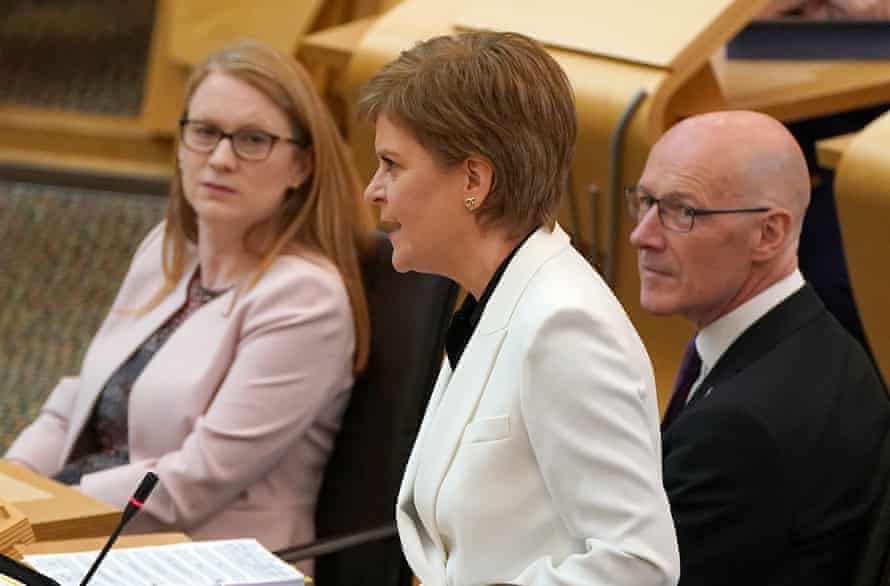 Nicola Sturgeon during FMQs today. Photograph: Andrew Milligan/PA
Parliament should get power to compel witnesses to give evidence to Commons committees, MPs say
Witnesses should not be able to avoid giving evidence at inquiries after “an increasing number of rich and powerful” people have done so in recent years, MPs have said. As PA Media reports, the Commons committee of privileges has published a report recommending legislation which would ensure parliament can compel witnesses to turn up to the House of Commons when summoned.
Explaining the recommendations, Chris Bryant, who chaired the committee when it was carrying out its inquiry, said:
The right of select committees to summon witnesses and hold the powerful to account cuts to the heart of our parliamentary democracy.
Most witnesses are more than happy to give evidence to a Parliamentary inquiry.
But an increasing number of the rich and powerful have started to resist engaging with select committees in recent years and, in doing so, have shown contempt for Parliament and the people it represents.
From billionaire high street moguls to unaccountable government advisers, these proposals will make it tougher for such individuals to disregard their democratic duty.
Our proposals, if approved by the house, will empower select committees to compel reluctant witnesses to attend or provide documents to parliamentary investigations - allowing committees to conduct their work efficiently and fairly.
The Trade Remedies Authority has put out a statement in response to the letter from Boris Johnson to Lord Geidt earlier today, which says Geidt resigned after being asked to advise on a matter related to the TRA. (See 12.01pm.) The TRA says this refers to a case “called in” by the government, which means ministers have “full decision-making authority” in relation to it.
In other words, the TRA seems to be saying: don’t blame us.
These are from Paul Caruana Galizia from Tortoise, who has a new detail about a well-documented party that Boris Johnson attended in Evgeny Lebedev’s villa in Italy in April 2018.
Here are two more people who find the circumstances of Lord Geidt’s resignation curious.
This is from Mark Reckless, a former Conservative MP who went on to lead the Brexit party in the Senedd.
And these are from Sir Jonathan Jones, who was head of the government’s legal department until he resigned over the government’s plans to break international law with the internal market bill.
UPDATE: According to David Anderson, a peer and former independent reviewer of terrorist legislation, even though the explicit reference to having to obey international law was removed from the ministerial code (Mark Reckless’s point above), an implicit obligation to follow international law remained.
At the Downing Street lobby briefing the prime minister’s spokesperson said ministers would not be getting directly involved in talks to stop the rail strikes next week. The spokesperson said:
Broadly speaking, we remain of the position that it is for the unions to negotiated with their employers rather than the government stepping in, there’s no change in that approach.
Proposed legislation to enable the use of agency workers on the railways if the industrial action persists would take “weeks rather than months”, the spokesman added.
The Foreign Office has announced a fresh wave of sanctions against Vladimir Putin’s allies, including on officials involved with the “barbaric treatment of children in Ukraine”, PA Media reports. PA says:
Each individual has been dealt an asset freeze preventing them from dealing with British banks or businesses, and a ban on flying to the UK.
Those sanctioned include the Russian children’s rights commissioner, Maria Lvova-Belova, who has been accused of enabling 2,000 vulnerable children to be violently taken from the Donbas region for adoption in Russia.
The measures also apply to the head of the Russian Orthodox Church, Patriarch Kirill, who supports Putin’s war, and Sergey Savostyanov, the deputy of the Moscow city Duma.
Speaking in the Commons, Liz Truss, the foreign secretary, said Patriarch Kirill has “repeatedly abused his position to justify the war”.
This is from Angela Rayner, Labour’s deputy leader, on Lord Geidt’s resignation letter.
Lord Geidt walked out because of the odious behaviour of Boris Johnson’s Downing Street. This prime minister has, in his own adviser’s words, made a mockery of the ministerial code. He has now followed both his predecessor and the anti-corruption tsar out of the door in disgust.
There are now no ethics left in this Downing Street regime propped up in office by a Conservative party mired in sleaze and totally unable to tackle the cost of living crisis facing the British people.

It’s a funny old world. Boris Johnson lies, breaks the law and ignores every ethical convention in public life and… his ethics adviser resigns.
At times like this one ought to be forgiven for recycling the tired old line from Lady Bracknell in The Importance of Being Earnest: “To lose one independent adviser on ministers’ interests, Mr Johnson, may be regarded as a misfortune; to lose two looks like carelessness.”
The Importance of Being Christopher (Lord) Geidt is that he was there to try and stop the prime minister from destroying himself. He was Boris Johnson’s ethics adviser. It's like a joke job title, akin to being Patrick Stewart’s chief hair stylist or being put in charge of wardrobe on Naked Attraction. Undignified at best.
Only a man imbued with the ethos of public service could have put up with the being treated with open contempt by Johnson. Geidt might have worked harmoniously as private secretary to Queen Elizabeth II of the United Kingdom of Great Britain and Northern Ireland, but we all know Johnson wanted to be “World King” at age 8, and he behaves as if he made it. Like Sir Alex Allan before him, Geidt had to go. Johnson’s outrages were too much for him, and when Geidt made his views on Johnson clear to a Commons select committee (albeit in code), his position was no longer tenable. A marriage made in hell is over.
Poor old Geidt. Johnson couldn’t be bothered to meet him, and Geidt was reduced to writing passive-aggressive missives in his annual report, basically whingeing about his boss. He ended up in a position where, as he explained, he couldn’t give Johnson the correct advice because if he did he knew Johnson would ignore him and that would put him in such an impossible position that he’d have to quit.
Instead, oddly enough, Geidt told a select committee of MPs, and thus indirectly told Johnson (and the rest of us), that he thought the PM was bang to rights. Or in fluent Geidtspeak, “I think it's reasonable that some – and indeed many people had written to me making this point – it's reasonable to say that, perhaps a fixed penalty notice and a prime minister paying for it, may have constituted not meeting the overarching duty under the ministerial code, of complying with the law”.
So let’s just be clear now. Having taken everything into account – Sue Gray, the Met, statements to the Commons, interviews, Dom’s blog, chats with other officials – the prime minister’s very own independent adviser on ministerial standards concludes that Johnson broke the ministerial code, and thus logically ought to resign. It’s quite something, punch drunk as we all are by long-term exposure to Johnson’s unique approach to truth and decency.
Of course, Johnson won't quit until he has to. The immediate consequences are grimly predictable. Geidt's position will be left vacant for as long as possible, to maximise Johnson's freedom, and then some crony given the role. Johnson has already rewritten the ministerial code to weaken it. He might even abolish Geidt's old job. He'd certainly like to.
Johnson’s remaining allies will quietly rubbish Geidt as an unworldly fuddy-duddy courtier out of his depth on the grown-up Fight Club of contemporary British politics: The truth is for cissies, laws are for losers, advisers, schmadvisers. No one in the Red Wall has heard of Geidt. He doesn’t matter. People know Boris doesn't do detail. We want to move on… big calls… vaccine roll-out… Ukraine loves Boris… beergate… draw a line… matter closed… levelling up… jobs, jobs, jobs.
You know the script. But Geidt will get his side of the story out, one way or another, and the stiletto will be plunged between the PM's shoulder blades. More Tory MPs will be convinced he is a liability. In a week's time the voters in the two by-elections, in Yorkshire and in Devon, will speak for England. When they do, Tory MPs will soil themselves. Nothing panics this lot like a double-digit swing to the opposition and some muscular tactical voting in a by-election, and it wouldn’t take that much more for them to finally decide to ditch Big Dog for good. With Geidt’s connections at the Palace, I doubt Johnson will find himself given a knighthood as compensation.
Andrew Woodcock reports. Nguồn bài viết Du học Đồng Thịnh | (+84) 96 993.7773 | (+84) 96 1660.266 | (+44) 020 753 800 87 | info@dongthinh.co.uk

Post a Comment