


Talks to avert a second national rail strike collapsed in rancour as the two sides traded insults in a bitter war of words as millions of passengers faced another day of disruption.
In increasingly fraught negotiations, the head of the RMT hit out at the transport secretary, Grant Shapps, for “wrecking negotiations” in the dispute over pay, working conditions and proposed “modernisation” plans to cut costs after the pandemic.
Shapps said the RMT claim was “a total lie”, while Network Rail claimed the union had walked away from talks.
The rail industry asked passengers to travel only if necessary on Thursday, when fewer than one in five trains in Great Britain are expected to run as 40,000 RMT members working for Network Rail and 13 train operating companies go on strike. Services will be sporadic and limited to mainlines and urban areas between the hours of 7.30am and 6.30pm.
Drivers from the Aslef union will also join strike action on Thursday on the Greater Anglia network.
The RMT general secretary, Mick Lynch, blamed the transport secretary for the failure of talks: “Grant Shapps has wrecked these negotiations by not allowing Network Rail to withdraw their letter threatening redundancy for 2,900 of our members.
“Until the government unshackle Network Rail and the train operating companies, it is not going to be possible for a negotiated settlement to be agreed.
“We will continue with our industrial campaign until we get a negotiated settlement that delivers job security and a pay rise for our members that deals with the escalating cost of living crisis.”
Shapps responded: “This is a total lie from the RMT and its general secretary. I have had absolutely nothing to do with either the issuing of a letter from Network Rail, the employer, to the RMT – or any request to withdraw it.”
In a letter to the RMT leadership on Monday, Network Rail gave notice that it would start a formal process enabling 1,800 redundancies from 1 July, incorporating compulsory redundancies if necessary. It said it could not delay any longer plans to reform its maintenance regimes.
Advertisement
Shapps added: “The RMT continues to deflect from the fact that the only people responsible for the massive public disruption this week is them. I want to urge Mick Lynch and his members to stop wasting time making false claims in the media and instead return to the negotiating table so an agreement can be reached.”
A Network Rail spokesperson said: “We are disappointed that the RMT have again chosen to walk away from negotiations without agreeing a deal. We remain available for talks – day or night – and will do everything we can to avoid further disruption for our passengers.”
A Rail Delivery Group spokesperson, representing train operators, said: “We call on the RMT leadership to continue to talk so that we can secure a thriving long-term future for the railway and its workforce.”
The union has rejected offers of pay increases worth up to 3% from Network Rail and train operators, and has indicated it wants a cost-of-living settlement more closely linked to the RPI measure of inflation, which hit 11.7% in May.
Rail staff at Merseyrail in the TSSA union voted to accept a 7.1% pay increase on Wednesday, and is believed the RMT is seeking a similar offer nationwide.

Although the government has refused to get involved in negotiations, saying it was a matter for employers, the industry is currently bankrolled by the Treasury. Downing Street said on Wednesday it would be “reckless” to raise public sector pay in line with inflation.
The daily Business Today email or follow Guardian Business on Twitter at @BusinessDesk
The prime minister’s spokesperson said: “It’s important to stress that does not mean we do not want to reward public sector workers with a pay rise, we do, it’s just we must make sure that we don’t do anything that has a knock-on impact which feeds into this global inflationary spiral that there is the potential to see.”
The first day of strike action on Tuesday, which also coincided with a London Underground strike by another 10,000 RMT employees, saw relatively few passengers attempt to travel on the services that remained running, but crowded buses and jammed roads around the capital. Elsewhere, congestion appeared only slightly worse, with many people now able to work from home.
Services were also disrupted on Wednesday morning, between the first two of the three planned strike days this week, with a later start in many areas and about 60% of the normal schedule planned to run across the day.
However, Great Western Railway said it had been able to operate more “Glastonbury specials” to accommodate people travelling to the festival than it did in 2019, with nine departures from London Paddington to Castle Cary on Wednesday and five more planned during tomorrow’s strike.
Meanwhile, bus workers at Stagecoach in Merseyside have voted to go on strike from the end of next week. The walkouts would join ongoing strikes in Yorkshire by drivers and depot workers for Arriva, which have stopped many services across the county for more than two weeks. More Arriva staff across north-west England are being balloted for strike action over pay.
This live blog is now closed.Second day of strike action to go ahead after talks fail again
Johnson ‘hasn’t lifted a finger’ to solve rail strikes, says Starmer
Labour frontbenchers who joined strike pickets pressed to apologise
Moderna has announced that it will open a vaccine research and manufacturing centre in the UK. In a visit to mark the announcement, Sajid Javid, the health secretary, said:
We all saw during the pandemic the differences that cutting edge vaccines and treatments can make and we all particularly saw that the mRNA technology has been very transformational. It has literally saved millions of lives over the last couple of years.
And that’s why I’m thrilled to announce this new partnership between the UK government and Moderna, where Moderna will established here in the UK, a global R&D facility with over £1bn for investment in this cutting edge technology, and also a huge manufacturing centre, their largest outside of the US, and so this is a great investment in the UK, and gives huge confidence to our life sciences sector already leading in Europe.
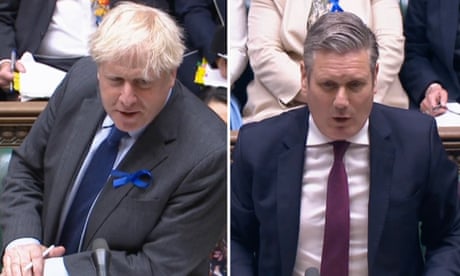
Keir Starmer has accused Boris Johnson of being more interested in “blaming everyone else” rather than expending any effort to resolve rail strikes, as the Labour leader repeatedly lambasted the prime minister for not doing his job.
Directly taking on government attempts to portray Labour as complicit in the rail stoppages because of the party’s union links, Starmer used prime minister’s questions to portray Johnson as self-interested and passive.

While Johnson repeatedly sought to condemn Starmer for not having “the gumption” to prevent Labour MPs supporting the RMT union and joining picket lines at the first of three scheduled rail strikes on Tuesday, Starmer said this was a clear attempt to deflect any responsibility.
Shapps says RMT claim he wrecked talks ‘a total lie’ as Thursday’s rail strikes set to go ahead – as it happened
Read more
“If he’s genuine about preventing strikes, could the prime minister tell this house how many meetings he or his transport secretary have had with rail workers this week to actually stop the strikes?” Starmer asked.
After Johnson evaded the question, Starmer went on: “There you have it – the prime minister of this country and his transport secretary haven’t attended a single meeting, held a conversation or lifted a finger to stop these strikes.”
The Labour leader contrasted this with Johnson’s attendance at a Conservative fundraising ball on Monday night, at which dinner with the prime minister was auctioned for £120,000.
“If there’s money coming his way he’s there. If it benefits the country, he’s nowhere to be seen. So rather than blame everyone else, why doesn’t he do his job, get round the table and get the trains running?” Starmer asked.
Johnson said: “As he knows, it is up to the railway companies to negotiate. That is their job.” He then reiterated his criticism of Labour MPs backing strikers.
Starmer replied: “He can’t help himself. There’s a huge problem facing the country and all he is interested in doing is blaming everyone else. Can’t he hear the country screaming at him: get on with your job?”
The Labour leader contrasted government calls for restraint from workers in seeking pay rises with reports Johnson personally lobbied for a change to rules that would allow UK-based bankers to have larger bonuses.
Another source, an MP, said the whips were “threatening people at the moment, trying to get them to issue apologies”. It is unclear what the consequences would be if they refused to apologise.
Meanwhile, Starmer is under pressure from some members of his shadow cabinet to drop the threat of disciplinary action.
One shadow minister said it would be “outrageous” to caution, or even sack, Labour MPs for showing solidarity with striking railworkers.
Another shadow cabinet member suggested it had been the right decision to encourage MPs to stay away from the frontline of the strikes, as Labour tries to look like a future government – but wrong to turn it into a show of strength.
No final decision is expected to be made about how to handle the errant MPs until after this week’s RMT strikes are over.
Five frontbenchers defied Starmer’s order, which was issued in a memo from the leader’s office on Monday, telling his shadow cabinet they should discuss with their teams the need to show “leadership” by staying away.
“Please be reminded that frontbenchers including PPSs [parliamentary private secretaries] should not be on picket lines,” the message said.
In the event, three PPSs, one junior minister, Alex Sobel, and a whip, Nav Mishra, posted pictures of themselves attending the first of three days of industrial action on Tuesday.
Labour’s Scottish leader, Anas Sarwar, who was also pictured alongside striking railworkers, tweeted that the government was to blame for failing to avert industrial action.
Advertisement
Starmer’s deputy, Angela Rayner, a former union rep who has regularly appeared on picket lines in the past, also tweeted her support for the RMT strike without attending in person, saying “workers have been left with no choice”.
Starmer’s decision to order colleagues to give the picket lines a wide berth has caused irritation among many Labour MPs.
Some frontbenchers have even privately suggested that if any of their colleagues were sacked by Starmer as a result, they would then show their anger by attending a picket line themselves.
Starmer has been keen to avoid being caricatured by the Conservatives as supportive of the strikes – the most widespread action on the railways for three decades.
A Labour source said: “Keir’s Labour party is on the side of the public, and our decisions are driven by that. Not everyone will like it, and we’re prepared for that, but that’s how we’ll prove ourselves as a serious operation, a serious government in waiting, and is how we’ll win elections.”
Shadow transport secretary Louise Haigh has repeatedly attacked her opposite number, Grant Shapps, for refusing to sit down with both sides and try to negotiate a deal.
The Labour leader has also repeatedly seized on opportunities to demonstrate that he takes a different approach from his predecessor, Jeremy Corbyn, a staunch supporter of union action who was often found on picket lines. During his early months in the post, Starmer’s slogan was “a new leadership”.
At prime minister’s questions, Starmer set the rail disruption alongside a series of government failings, including backlogs for renewing passports and cancelled flights. He said the government hadn’t “lifted a finger” to prevent the strikes.
* Nguồn bài viết Tư vấn du học Anh Quốc - Quốc Tế Du Học Đồng Thịnh dongthinh.co.uk (+84) 96 993.7773 | (+84) 96 1660.266 | (+44) 020 753 800 87 | info@dongthinh.co.uk

Post a Comment