

UK risks EU trade war as Northern Ireland protocol bill is published The Guardian
Boris Johnson says plan to amend Northern Ireland protocol 'not a big deal' Guardian News
Editorial: Playing games with the Northern Ireland protocol puts the UK at risk The Independent
Reject EU intransigence over NI Protocol changes - Brian Monteith The Scotsman
EU poised to take legal action against UK over Northern Ireland protocol bill

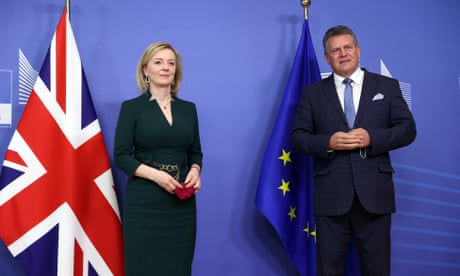

The last time the government tried to breach international law, at least it was – uncharacteristically – open about it. Back in September 2020, there was, as now, a proposal to override the UK’s Brexit treaty obligations as laid out in the Northern Ireland protocol. Then, also as now, Brandon Lewis was secretary of state for Northern Ireland, and he was good enough to tell the House of Commons: “Yes, this does break international law in a very specific and limited way.” Which, as any miscreant up before the beak might attest, isn’t going to make everything all right.
Now though, perhaps chastened by his previous candour, Mr Lewis tells it differently. The new line is that it is perfectly legal, and will obviously be so when the relevant bill is published. The legal basis for the legislation will be presented to parliament, but not the legal case or reasoning. That is not going to make things all right, either.

On the other hand, it will further alienate other party members who are losing confidence in him and have promised to stage guerrilla warfare on this bill (which was obviously not in the manifesto). Even if the bill becomes law, it might require ministerial decisions to put it into effect. Until enacted by customs officers and vets in Larne, the threat of illegality won’t be turned into an actual breach of international law. The crunch may be a long way off, but the damage is being done now.
This is no time to gamble with the Irish peace process or the British economy. The government bill proposes to override the right of the Northern Ireland assembly to approve or reject the protocol in a vote due in 2024. This obviously has nothing to do with red tape at the border, phytosanitary controls or sandwiches shipped from England. It is a purely political ploy, aimed at appeasing the DUP - and with an eye on the majority that now exists, and will probably continue to exist, in the Northern Ireland assembly, which actually accepts the protocol and does not want not abandon it. but simply to reform it.
To keep up to date with the latest reviews and comments, sign up for our free weekly newsletter Voices Dispatches by clicking here
Insufficient thought seems to have been given to the consequences of Sinn Fein withdrawing from the Good Friday Agreement. It doesn’t need that much imagination; a passing acquaintance with the history of the Troubles is sufficient.
This fear factor is already in play, as a trade war between the UK and the EU is the inevitable - and legal - consequence of the UK reneging on its obligations under international treaty law and the EU. ignorance of existing arbitration procedures. An investor strike, coupled with high inflation and a labor shortage, will leave the UK economy among the weakest in Europe, with living standards to match. So much for the “oven-ready” deal and “the Brexit we voted for”.
You will hear it said the EU has tried to negotiate a resolution but is frustrated by the failure of the UK Government to participate – but this is a disingenuous and self-serving word salad. The reality is somewhat different. Our Government has shown remarkable patience, if not uncalled for and unnecessary generosity towards the EU, by not suspending Article 16 of the Protocol – the section of the Withdrawal Agreement that allows for action to be taken by either the EU or the UK when faced with “serious economic, societal or environmental difficulties that are liable to persist, or to diversion of trade” – as is its right. Instead it is trying a different, if no less controversial, approach by introducing a Bill that will allow it to overrule certain aspects of how the Protocol operates.
Naturally the EU, the Irish government, nationalists and EU supporters in the UK will launch a tirade against Boris Johnson and Foreign Secretary Liz Truss who is handling the bill, but they are on weak ground. There is no doubt that the Protocol causes trade diversion within the UK and that alone is a sufficient condition to allow the Protocol to be suspended. Official trade figures from the UK and Ireland indicate trade diversion and individual examples of such distortions abound.
 Prime Minister Boris Johnson and Foreign Secretary Liz Truss must stand firm against EU negotiators (Picture: Evan VucciAFP/Getty)
Earlier this year the Stormont Agriculture Minister, the DUP’s Edwin Poots, instructed Northern Ireland border officials to halt their customs inspections, especially on foods arriving from Great Britain on the grounds the inspections had not received the official agreement of the Stormont Executive.
Boris Johnson says plan to amend Northern Ireland protocol 'not a big deal' Guardian News
Editorial: Playing games with the Northern Ireland protocol puts the UK at risk The Independent
Reject EU intransigence over NI Protocol changes - Brian Monteith The Scotsman
EU poised to take legal action against UK over Northern Ireland protocol bill
He justified the move under a principle called the 'doctrine of necessity', saying the protocol posed 'peril' to society and politics in Northern Ireland due to the threat to the deal of Good Friday.
Boris Johnson has insisted the changes to the legislation are 'relatively insignificant' measures designed to ease trade disruption between Northern Ireland and the rest of the UK, as the bill was published on Monday .
But the EU said it would take legal action for breaching the protocol and a majority of Northern Ireland assembly members accused Johnson of being reckless in destabilizing the Good Friday Agreement.
Under the new legislation, which is expected to face considerable opposition in parliament, the government would scrap checks for businesses selling goods from Britain destined for Northern Ireland rather than the EU. Instead, the government is considering the creation of a 'green lane' with fewer checks for those selling goods destined for Northern Ireland and a 'red lane' with existing checks for goods destined for Northern Ireland. EU countries.
It would also allow UK companies exporting to Northern Ireland to choose between meeting EU or UK regulatory standards, which are expected to increasingly diverge.
Other measures include aligning Northern Ireland's tax relief and spending policies with those of the rest of the UK, and changing the oversight of commercial disputes so that they are resolved through arbitration. independent rather than by the European Court of Justice – a clause pushed by conservative eurosceptics.
02:33EU will not renegotiate Northern Ireland Protocol, says European Commission - video
Maroš Šefčovič, EU Brexit Commissioner, denounced the "damaging" decision and threatened to bring the ministers to justice.
Advertising
He said: “As a first step, the commission will consider continuing the infringement proceedings launched against the UK government in March 2021. We had suspended this legal action in September 2021 in the spirit of constructive cooperation to create the space for seek common solutions. The UK's unilateral action goes directly against the spirit.
The EU will on Wednesday relaunch legal action against the UK over the government's failure to carry out checks on agri-food products and launch two new 'infringement proceedings' for failing to set up border posts and share data with the European Commission.
Speaking after the bill was published, Thomas Byrne, Ireland's Minister for European Affairs, told LBC that "there will undoubtedly be consequences".
"If you cross a red light you will be punished, if you commit any other violation of the law you will be punished," he said. "There will be consequences for Britain, but we don't want to get into that space. We want this to be settled between the two parties for the good of Northern Ireland. »
Annalena Baerbock, Germany's foreign minister, accused Johnson of playing politics with peace in Northern Ireland.
She tweeted: “As the EU, we have put concrete proposals for solutions on the table. With a strong vision for: the citizens and businesses that benefit every day from the EU single market. And the preservation of the Good Friday Agreement. Peace and prosperity on the island of Ireland is not a pawn.
Legal experts were quick to question the government's justification for flouting international law. David Anderson, a crusader peer, barrister and visiting professor at King's College Law School, said it "looks thin to me, not to say worn down", while Emily Thornberry, the shadow attorney general, said the argument was "complete and absolute". absurdity".
In its legal summary, the government said: "This is a truly exceptional situation and it is only in the difficult, complex and unique circumstances of Northern Ireland that the government has reluctantly decided to introduce legislative measures which, upon their entry into force, provide for the non-performance of certain obligations.
“The position of the government is that in view of the state of necessity, such non-performance of its obligations contained in the withdrawal agreement and/or the protocol following the legislative measures envisaged would be justified under international law. .”
He argued that the "peril" in Northern Ireland was "not inherent in the provisions of the protocol".
The legislation is likely to meet serious opposition in the House of Commons and Lords, with doubts over whether Boris Johnson has the support for it to pass. Ministers are also likely to come under pressure to publish the full legal opinion on the move, as well as the impact assessment which was not published with the bill.
The legislation has criticism on the eurosceptic right as well as a nation's centrist wing of conservatives.
Government sources said they hoped a vote on the bill would take place before parliament broke for the summer recess, but ministers would like to see progress towards a return to power-sharing in Northern Ireland first, what the Democratic Unionist Party (DUP) has so far blocked. Sir Jeffrey Donaldson, the leader of the DUP, did not say whether his party would return to the assembly or give its full support to the bill, but said: 'The UK government is right to act and we look forward to it. fully examine this legislation. ”
A majority of Northern Ireland assembly members - from Sinn Féin, SDLP and the Alliance party - wrote to Johnson on Monday saying they could not support the move as it "goes against wishes expressed not only by most businesses, but most people in Northern Ireland”.
The assembly must vote on whether to consent to the operation of the protocol in 2024, four years after it comes into force.
With the opposition mounting, there are doubts among MPs that the legislation will go anywhere. The government has insisted that it still prefers to find a negotiated solution to resolve protocol issues. But Ireland said on Monday that Foreign Secretary Liz Truss had not engaged in meaningful negotiations with the protocol since February.
A phone call on Monday morning between Truss and Simon Coveney, Dublin's foreign minister, lasted just 12 minutes. A spokesperson for the Irish Foreign Office said: "Mr Coveney said the publication of legislation which would breach the UK's commitments under international law, the Brexit Withdrawal Agreement and the Protocol of Northern Ireland is deeply damaging to relations on these islands and between the UK and the EU."
Now though, perhaps chastened by his previous candour, Mr Lewis tells it differently. The new line is that it is perfectly legal, and will obviously be so when the relevant bill is published. The legal basis for the legislation will be presented to parliament, but not the legal case or reasoning. That is not going to make things all right, either.
Indeed, there is already cause for suspicion. As Mr Lewis toured the TV studios, he made it clear that government legal advice was not going to be published, despite intense public interest. Of course, all legal advice is confidential, but if it were to help Boris Johnson out of a tight corner, he would surely be happy to disclose it in full, or publish it.
As Theresa May found out before, the House of Commons has the power to compel the government to carry out the legal opinion. It is not the first time that the Prime Minister seems to have something to hide.
Despite the helpful efforts of Attorney General Suella Braverman, the court case may not be as watertight as Mr Johnson would like. For example, the Treasury's first solicitor, James Eadie QC, was not, as might have been expected, consulted specifically on the legality of the new legislation, but was told to assume that there was a respectable legal basis for the government's position. The impression is that of a government seeking legal advice that suits it politically. Again, such a strategy may not withstand judicial scrutiny.
Even to a lay observer, it seems obvious that even if the new bill could become valid domestic law, it would still in fact violate an international treaty obligation if it were ever implemented. Perhaps Mr Johnson is using it as a negotiating ploy in his bid to get the EU to renegotiate the deal. It might work (unlikely) but would also buy him time for his critics on the Eurosceptic right and save his job for a few still vital months.
This is no time to gamble with the Irish peace process or the British economy. The government bill proposes to override the right of the Northern Ireland assembly to approve or reject the protocol in a vote due in 2024. This obviously has nothing to do with red tape at the border, phytosanitary controls or sandwiches shipped from England. It is a purely political ploy, aimed at appeasing the DUP - and with an eye on the majority that now exists, and will probably continue to exist, in the Northern Ireland assembly, which actually accepts the protocol and does not want not abandon it. but simply to reform it.
Insufficient thought seems to have been given to the consequences of Sinn Fein withdrawing from the Good Friday Agreement. It doesn’t need that much imagination; a passing acquaintance with the history of the Troubles is sufficient.
The economic effects on Northern Ireland and the wider UK economy of these silly games are already detrimental. Companies, especially those based overseas, will not make major investments in the UK economy when faced with the possibility of a trade war between Britain and Europe. Why would they, if their exports to the EU, which remains by far the UK's largest market, could face punitive tariffs and the UK faces a deeper recession? Uncertainty kills business confidence.
Naturally the EU, the Irish government, nationalists and EU supporters in the UK will launch a tirade against Boris Johnson and Foreign Secretary Liz Truss who is handling the bill, but they are on weak ground. There is no doubt that the Protocol causes trade diversion within the UK and that alone is a sufficient condition to allow the Protocol to be suspended. Official trade figures from the UK and Ireland indicate trade diversion and individual examples of such distortions abound.
Prime Minister Boris Johnson and Foreign Secretary Liz Truss must stand firm against EU negotiators (Picture: Evan VucciAFP/Getty)As someone who monitors activity, I repeatedly find new examples which, if they existed in Scotland or the rest of the British mainland, would cause apoplexy and outrage leading to media campaigns and demonstrations.
Imagine fishing boats leaving Peterhead, Whitby or Grimsby and not being allowed to land their legally permitted catches in their own port from which they departed without having to go through enormous bureaucracy and costs that treat them as if they came from Iceland or Russia. The only reason there is no problem at the moment is that the British government has introduced - unilaterally - a grace period, first of six months, then extended indefinitely, which cancels the checks on which the EU insists.
Even food destined for Sainsbury's supermarkets - a company which has no stores in the Republic - is subject to the EU's overzealous controls, which are meant to protect the EU's internal market.
Scots should be concerned about this. There are many examples of Scottish businesses which have already stopped or are considering stopping trading with customers in Northern Ireland because of the obstacles the EU have put in place. Scottish seed potatoes cannot now be sold across the Irish Sea, nor can Christmas trees – both lucrative markets for Scottish farmers. This is a fundamental breach of the Acts of Union 1707 and 1801 that guarantees open and free trade within the United Kingdom between Scots and Northern Irish members of the UK (as well as between all of its citizens in general).What EU negotiator Maros Sefcovic has proposed is to make minor concessions on the number of checks on food and goods arriving in Northern Ireland from the rest of the UK in exchange for the UK's acceptance that the protocol will become permanent, rather than the time-limited temporary arrangement under which it was established. It's not a negotiation - it's a power grab and politicians like Sir Keir Starmer are falling for it.
Critics say the UK should not act unilaterally in bringing the bill forward, but it was the unilateral action of grace periods that forced the EU to even agree to meet Lord Frost and then Liz Truss as Previously, they had said there would be no negotiations.
Interestingly, the challenge to powers to control goods from the UK mainland is currently under judicial review.
Earlier this year the Stormont Agriculture Minister, the DUP’s Edwin Poots, instructed Northern Ireland border officials to halt their customs inspections, especially on foods arriving from Great Britain on the grounds the inspections had not received the official agreement of the Stormont Executive.
This was immediately challenged in the High Court in Belfast by Sinn Fein supporters. The inspections continued in the meantime while the full hearing took place. As EU legislation describing the UK has never been amended to say that checks must be carried out between "Great Britain" and "Northern Ireland", the checks that have taken place actually happen in the UK and not when the food, goods and animals enter the EU - where they must legally happen under EU law.
It has been argued that legally Northern Ireland is outside the EU but aligned to its internal market - so animals, food and goods only enter the EU when passing through the Republic of Ireland, not when entering Northern Ireland. The British government was called upon to contradict this argument but refused to do so. We therefore have the possibility that the court declares the outstanding checks illegal.
For the EU to carry out the checks it requires would mean that they would take place at or behind the Irish border with the UK. Ironically, the UK has always said it would happily provide technology solutions that would eliminate the need for physical controls or any hardware infrastructure, thus fulfilling the Belfast/Good Friday deal. It has always been the EU and the Irish government that have insisted on placing such controls in the ports of Northern Ireland.
A court ruling could soon overtake the need for the UK Government's Protocol Bill - and remove the need for the current protocol altogether.
Nguồn bài viết Du học Đồng Thịnh | (+84) 96 993.7773 | (+84) 96 1660.266 | (+44) 020 753 800 87 | info@dongthinh.co.uk

Post a Comment