

Students across England, Wales and Northern Ireland will receive their GCSE results on 25 August 2022.
In England, these are now graded using a numerical system from 9 to 1, rather than from A to E, as was previously the case.
What are the new grades?
The 9-1 grading scheme was brought in alongside a new GCSE curriculum in England.
The highest grade is now 9, while 1 is the lowest. The U grade, meaning "ungraded", remains the same.
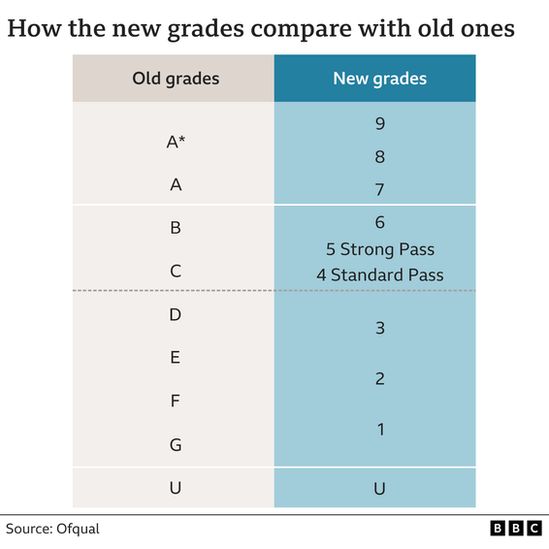
The number scale is not directly equivalent to the old letter one. However, the two scales do meet in certain places:
- the bottom of grade 7 is aligned with the bottom of grade A
- the bottom of grade 4 is aligned with the bottom of grade C
- the bottom of grade 1 is aligned with the bottom of grade G
- three number grades - 9, 8 and 7 - correspond to the two previous top grades of A* and A
Exams watchdog Ofqual says fewer grade 9s will be awarded than A*s "to identify exceptional performance".
What do pupils need to pass their exams?
Pupils need a 4 for a "standard pass" and 5 for a "strong pass".
This means that a candidate who gets nine grade-4s has, technically, passed all their exams.
However, the government's school league tables are based on the percentage of pupils who achieve a 5 or above in English and maths GCSEs.
Many sixth forms insist on a minimum number of 5s or 6s as a condition of entry for further study.
 GETTY IMAGES
For the past two years, results were based on teacher assessments, and the number of pupils receiving top grades in England, Wales and Northern Ireland increased.
Exams will be graded more generously this year to reflect the serious disruption students experienced during the pandemic.
Why were the grades changed?
The numerical grading scheme was introduced as part of a 2014 curriculum overhaul by then-Education Secretary Michael Gove.
It put less emphasis on GCSE coursework than before, with grades in almost all subjects decided in final exams.
The qualifications were designed to be more challenging, with exams taken after two years of study. Previously pupils covered the syllabus through a series of modules with regular assessments throughout the course.
At the time of the changes, the government argued that the new scale "recognises more clearly the achievements of high-attaining students, as the additional grades allow for greater differentiation".
It also said that the move from letters to numbers would make it clear - for example to an employer - "whether a student has taken a new, more challenging GCSE, or an old reformed GCSE".
How are GCSEs graded in Northern Ireland?
The grading rules changed in Northern Ireland too.
In summer 2019, the Northern Ireland Council for Curriculum, Examinations and Assessment (CCEA) introduced a new nine-category grade scale - A* to G, including a C*.
But students may also get results with grades 9-1 if they take exams set by English boards.
How are GCSEs graded in Wales?
The Welsh government introduced new and revised GCSE courses in September 2015.
The most significant changes were in English language, Welsh language and mathematics.
Wales retained the letter-based grading structure A*- G.
* Nguồn bài viết Tư vấn du học Anh Quốc - Quốc Tế Du Học Đồng Thịnh dongthinh.co.uk (+84) 96 993.7773 | (+84) 96 1660.266 | (+44) 020 753 800 87 | info@dongthinh.co.uk

Post a Comment